
Live tweets from Day 200 of the Post Office Horizon IT Inquiry.
83 tweets
Hello and welcome to a busy and likely final hearing day (Day 200) of the Post Office Horizon IT Inquiry. Earlier BBC Breakfast created an impromptu studio to allow Nina Warhurst to interview Janet Skinner, Lee Castleton, St John and Tim Brentnall

The Post Office barrister Nicola Greaney KC is on her feet. She gave a cursory overview of the Post Office's failings throughout the scandal. Sample quotes:
"This inquiry has been a humbling experience not only for those that gave evidence but for those that currently work at Post Office or used to and who are all equally appalled by Post Office's failures. No one who has read and listened to the evidence during this inquiry could come to any conclusion other than that the Horizon IT scandal is the most widespread miscarriage of justice in British legal history and that its roots lay in fundamental structural and governance failings."
And: "Post Office acknowledges that the inquiry will rightly be critical of a number of individuals, not only from Post Office. It invites the inquiry to bear in mind the serious governance and structural failures that permitted their actions to be unchecked, resulting in failings to the detriment of Postmasters. Post Office raises this not to excuse but to explain the context in which those failures occurred."
And: "In the early phases, the Inquiry heard from witnesses who joined the Post Office in the 60s and 70s, several coming to occupy the most senior positions some 20 or 30 years later. A picture emerged of a company in the late 20th century and the early part of this century, which certainly at a senior level had little experience and understanding of the IT revolution which had already taken place in the United States. many other companies, on which it was inevitable that Post Office had to join. It is a source of deep regret to Post Office that the reliance on Fujitsu and of belief in the reliability of Horizon, which emerged in those early days, was allowed to take root within Post Office in the decades that followed."
And: "Post Office has referred in its written closings in earlier phases to a mindset that took hold in Post Office, to the effect that Horizon had no bugs, errors or defects. Such problems as did arise in Horizon were due to user error or dishonesty. A strong resistance to countenancing the existence of any flaws in Horizon. A mindset that saw it as an advantage not to keep postmasters informed about systems issues that were identified. A mindset that positively discouraged more widespread dissemination of information. A mindset that focused on protecting the post office brand and the commercial interests of the company. This mindset was compounded by an organisational hierarchy which meant that junior employees did not feel able to escalate issues upwards. This in turn resulted in insufficient overview being taken at scale. senior level. Important senior roles were occupied by individuals who regrettably lacked sufficient understanding of the obligations and responsibilities attaching to those roles. They either did not have sufficient personal experience of Horizon technology or were not sufficiently senior within the overall organisation to carry out those roles effectively."
Here the PO denies criminal activity on behalf of its execs: "Post Office has accepted in its written submissions for those phases that there was a series of governance failings in the organisation. Key information about Horizon and prosecution based on Horizon was not shared effectively, either horizontally or vertically within the Post Office, and there was no clear structure to ensure that relevant knowledge was consistently and appropriately communicated throughout the organisation. As Post Office has acknowledged in its written closing statement for Phases 5 and 6, the apparent lack of knowledge or understanding on the part of senior executives and board members that Post Office conducted its own prosecutions against Postmasters was particularly striking. When Post Office separated from Royal Mail Group in 2012, there was a failure to ensure board members and senior executives were briefed either on the fact that Post Office was a prosecutor or on the central importance of Horizon data to those prosecutions. There was a lack of clear lines of accountability for reporting on prosecutions to the board, which created the structural conditions for inadequate board oversight of prosecutions. This in turn severely reduced the board's effectiveness in holding the executive to account. Similarly, there was a failure to share the first Clarke Advice… with the Post Office board. This appears to have arisen from a collective failure on the part of the then Post Office legal team to appreciate its full significance and inadequate processes being in place for sharing the substance of key legal advice with the Board, rather than a deliberate attempt to prevent the advice being considered by the Board."
More: "Consistent with the prevailing mindset that has been revealed in the evidence in Phases 3 and 4, Post Office's response to the Second Sight interim report showed multiple failings on the part of the Executive. They adopted a defensive attitude from the start… and consistent with an assumption of Postmaster fault, refused to entertain the possibility that Horizon, or Post Office's treatment of Postmasters, including inadequate training and support were to blame. The evidence also shows that the board failed properly to scrutinise either the second site interim report or Susan Crichton's update paper for the July 2013 board meeting. Given the concerns raised about the existence of bugs, about Post Office's investigation function and about the treatment of postmasters, the board's failure to challenge the executive was a significant one, particularly given the concerns raised by the board about claims for wrongful prosecution leading to a notification to insurance."
Ms Greaney now turns to how great things are now:
"Since 2019, Post Office has taken steps to shift its focus to Postmasters. Post Office accepts that the pace of change in the organisation has been too slow. Post Office acknowledges that it has a lot of work to do in order to address its shortcomings and rebuild the trust of Postmasters that has been so severely damaged by its failures, and that it is actions rather than words that count. Post Office has implemented a number of changes since 2019 to start reorientating the business towards the interests of Postmasters, which I will deal with under the following headings. One, listening to the views of Postmasters. Two, changes to its discrepancy processes and the support it provides to Postmasters. Three, Horizon improvements. Four, cultural changes. five governance changes and six Post Office's plans for the future."
… "First, Post Office acknowledges that it failed to listen to and act on the concerns of Postmasters about the Horizon system. Since the events which are the subject of this inquiry, it has taken steps to bring the views of Postmasters into the centre of the business. Since June 2021, Postmaster NEDs have sat on the Post Office Board, which has enabled the views of Postmasters to be heard on matters of strategic and key operational importance. Following the recent appointment of two new Postmaster NEDs, continuity will be ensured remaining in post until June 2025. In addition to the Postmaster NEDs, in 2021, Post Office appointed a Postmaster Experience Director who spends two days a week in Post Office Head Office liaising with the executive teams to inform them about the operational experiences and concerns of Postmasters. Furthermore, Post Office has plans to expand the mechanisms for enabling the views of Postmasters to be heard and taken into account in the business."
"Second, Post Office has changed fundamentally the way it investigates discrepancy shown on the Horizon system and the support it provides to Postmasters. The Inquiry has read and heard detailed evidence from Tracy Marshall Retail Engagement Director, and Melanie Park, Central Operations Director. The burden of proof is now on Post Office to establish that a discrepancy is a genuine loss to the Post Office and the fault of the Postmaster or their assistant. This is a crucial step in addressing the imbalance of power that previously existed in Post Office's policies, procedures and practices. In cases where the Postmaster does not agree with the Post Office's position, there is a dispute button on Horizon that the Postmaster can press to raise a discrepancy or dispute the transaction correction that has been issued. There is a three-tier dispute resolution procedure and the option of a referral to a Dispute Resolution Review Committee. Post Office provides improved support to Postmasters through BranchHub, a digital platform which provides information, including manuals and training materials, to help and support Postmasters and their staff on a day-to-day basis, and which Postmasters can also use to report IT issues. Any defects or issues relating to Horizon are set out in knowledge articles, which are published on BranchHub within 48 hours of being identified. These articles serve an important role in ensuring Postmasters are kept up to date and have the information they need should a discrepancy arise. Post Office intends that these processes will be kept under review by the Postmaster Panel with the aim of ongoing improvement. The Inquiry will bear in mind that Post Office no longer exercises a prosecutorial function. It does not now and has no intention in the future of conducting its own criminal investigations or prosecutions. Post Office will support law enforcement agencies in their investigations as it plainly should."
"Third, the Inquiry has heard detailed evidence from Simon Oldenall, Branch Technology Director at Post Office, and Tracy Marshall in written and oral evidence that Post Office has worked hard through the Horizon Improvement Plan. programme to remediate bugs, errors and defects, including those identified by Mr Justice Fraser. It has put in place a programme to identify and fix any new bugs, errors and defects in Horizon and carried out significant work to establish an ongoing programme of improvements to a wide range of procedures across many parts of Post Office's operations, including training and business support. The Inquiry has also received detailed written evidence from Mr Oldnall about the way in which Post Office now better monitors Fujitsu's compliance with Fujitsu's own contractual obligations to provide a secure and reliable Horizon system. The Inquiry is aware that Post Office continues to be in ongoing discussions with Fujitsu about an extension to the Horizon contract."
"Fourth, the Inquiry has heard that from the end of 2019, Post Office has introduced initiatives intended to bring about cultural changes across the organisation. Post Office has recognised the need for fundamental cultural change. As Nick Reed said in his first statement to this Inquiry, Post Office recognises the presence of oppressive behaviour and intimidating actions in the past, which led to a lack of respect and trust between Post Office and its Postmasters. that there has been a lack of effective leadership, a lack of effective training and support, and a lack of responsibility within the organisation. It accepts that it has work to do to restore trust with Postmasters and with the public as a whole. Cultural changes in the Post Office are integral to the rebuilding of that trust. To remind the Inquiry, those initiatives to reset the Post Office's culture include the following. The introduction of new training modules, including substantial induction training, which educates new employees about the Horizon IT scandal, and mandatory Horizon Scandal training and GeoData. awareness. In June and July 2024, the Post Office launched a behaviours framework that applies to all those working in Post Office, which is intended to act as a guide and to instil behaviours that are seen as key to preventing a repeat of the wrongs of the past. New complaints channels have been implemented via… Postmaster Survey, College Engagement Survey and Strategic Partner Survey. These changes are not just aspirational, the new behaviours framework is embedded into the recruitment process and used to measure the performance of everyone at Post Office. The Board takes ultimate responsibility for ensuring that cultural change takes place. but every person working at Post Office has their part to play. Cultural change, of course, takes time, however, recognising that change has not happened quickly enough, Post Office has put in place plans, including a strategic people plan, which are intended to embed cultural change from the foundation of the organisation. upwards, focusing on building better relationships with postmasters with a real emphasis on restoring trust. A key objective of Post Office's recent strategic review, which I shall come on to talk about shortly, is the commencement of a new relationship between Post Office and Postmasters in which there will be a significant increase in postmaster remuneration, improved support and the strengthening of the postmaster voice. Post Office sees this proposal as underpinning the drive towards a reset of the culture in its business."
"Fifth, Post Office has acknowledged in the course of written closing statements made in respect of earlier phases including five and six, that there were serious governance failings in the organisation which played a substantial part in the injustices that occurred. Post Office commissioned Grant Thornton to review its corporate and operational governance in 2023. Post Office accepted Grant Thornton's conclusions that it requires a unifying strategy, greater role clarity, streamlined decision-making processes, significant improvements in succession planning and a cultural shift towards accountability and long-term planning. To address the need for a unifying purpose and group strategy, Grant Thornton considers lies at the heart of governance dysfunction at the Post Office, Post Office has commissioned a strategic review. Post Office has taken action to address governance issues identified by Grant Thornton where it has been able to pending the outcome of the strategic review. It has taken steps to improve the composition and competency of the board. The Interim General Counsel is now a standing attendee at board meetings. Action has also been taken to improve the quality of information on which the board reaches decisions and measures have been introduced to avoid the board being overburdened with issues that ought to be dealt with at executive level. level. The group executive, now called the Senior Executive Group, has been restructured so as to focus discussions better and improve the speed of decision-making. A wholesale review of executive committees is underway. Post Office notes the proposals put forward by others for alternative structures, including an oversight committee, as proposed by the NFSP. It also notes the view of the governance experts that responsibility and accountability should rest with the Board. The Post Office considers that at least to some extent the NFSP's proposals for an oversight committee will be addressed by proposal for a Postmaster Consultative Council which will work together with Post Office on the implementation of proposals arising from the strategic review."
"Sixth: through the strategic review, the new team at Post Office has put forward a proposal to government for the future of the Post Office which will enable it better to serve the interests of postmasters. and thereby the public that they serve. Post Office has been pressing for a review of government's policy as sole shareholder in respect of Post Office for some years. Post Office has been loss-making since its separation from RMG in 2012 and in the face of significant commercial and structural challenges. Those losses are expected to worsen in the future. The Government has nonetheless long held the view that Post Office should be financially self-sustaining and not rely on Government subsidy. Post Office is looking forward to receiving greater clarity from Ministers as to how that could or should be achieved and the policy objectives that would underpin it. Post Office considers that the changes that it seeks to make as part of implementing its strategic review will be far reaching into the benefit of Postmasters first and foremost, but also to the long term future of Post Office as a whole and the communities that are served by Post Office. out between June and September 2024, drew on members of Post Office staff, board members, postmasters and other stakeholders and experts. Nigel Railton, interim chair of Post Office, stated in his speech on 13 November 2024, "Fundamental to the implementation of the Strategic Review is Post Office's commitment to delivering the best possible service to plan to deliver a new deal for postmasters. This will significantly increase the total annual income of postmasters through a vastly improved share of revenues and strengthen their role in the direction of the organisation." The implementation of the strategic review will be informed by strong postmaster engagement through the establishment of a new consultative and a postmaster panel. The strategic review is also aimed at refocusing the post office's operations so that there is a streamlined central organisation which serves the interests of postmasters so that they may serve their communities via sustainable businesses. Nigel Relton, the interim chair, explained his evidence to the Inquiry that as a result of the strategic review and subject to DBT approval, Post Office proposes to reset the NBIT programme to improve confidence in its delivery and to ensure that it provides what Postmasters need. Post Office intends to work closely with Postmasters to define the new programme. The Post Office acknowledges that work needs to be done to ensure that its proposal remains aligned with the work being carried out by DBT, with Grant Thornton, Boston Consulting Group and the Government Internal Audit Agency. Post Office welcomes continued involvement in DBT's reviews."
Ms Greaney summarises: "Post Office considers that its plan to transform the Post Office offers the best opportunity for the organisation to flourish and benefit those whom it serves, namely Postmasters and the public. Post Office recognises that until all Postmasters receive full and fair address, there is no prospect of them achieving closure in respect… of these terrible events. Post Office remains fully committed to playing its part in ensuring that postmasters receive full and fair redress as quickly as possible. It has been the long-held view of Post Office that the compensation scheme should be run independently of Post Office because the perpetrator of injustice should not administer the assessment of redress. It is also Post Office's view that legal advice should be offered when the £75,000 fixed sum is offered to postmasters. Simon Recaldin has informed DBT of his view that there should be consideration of extending the schemes to family members and Post Office welcomes DBT's consideration of this. Post Office notes that DBT is providing an update on financial redress in its written submissions. Post Office regularly updates the HSS and the OCS webpages with the current figures. Post Office would be happy to provide further written updates to the inquiry as to the progress of the redress schemes if that would assist the inquiry. Furthermore, if the inquiry would be assisted by receiving written updates or further information from Post Office on other matters, then Post Office will of course provide such information as may be requested. Post Office would like to extend its thanks to Postmasters who have given evidence or engaged with this inquiry as participants or by responding to the YouGov survey… Post Office will reflect carefully on the findings in the forthcoming inquiry report and will take the Inquiry's recommendations extremely seriously. Post Office must end this Closing Statement as it began, with an apology. Post Office repeats its sincerest apology to all who have been affected by its actions, reiterates its determination to continue with the process of learning the lessons from this inquiry. Post Office remains firmly committed to ensuring that nothing like this could ever happen again, but acknowledges that it will rightly be judged in the months and years to come by what it does."
Okay we've had a quick break and Paula Vennells' barrister Samantha Leek KC is on her feet. PV's Witness Statement (WS) has already been published by the Inquiry here:
www.postofficehorizoninquiry.org.uk/evidence/subs0000071-closing-statement-behalf-paula-vennells

This is Samantha Leek – you can follow all this on the Inquiry youtube channel btw, here:
www.youtube.com/watch?v=8eSzFjErirQ

I'll start pasting up what is essentially the starting point for PV's criminal defence in a second. But first, here is a massive document dump to get your teeth into. All the closing statements and loads more WS's:
www.postofficehorizoninquiry.org.uk/hearings/closing-statements-16-december-2024
Vennells is basically pointing the finger at legal and IT and saying they didn't tell her what she needed to know. Mike Young and Lesley Sewell – both heads of IT – in particular.
Actually she's pointing the finger everywhere – Rod Ismay and Angela van den Bogerd getting it too.
Here we go:
"Sir, in our written submissions we have sought to analyse carefully and forensically the chronology of what Miss Vennells did and did not know about various key matters and what she did and did not do with knowledge. That document has now been published by the Inquiry. We submit that it is only by looking forensically at all of the documentation that a fair picture of Ms Vennells' actions can be seen. In the time we have allotted to us today, I shall highlight a number of points from our written submissions which go to information provided to Ms Vennells which was incomplete or incorrect, or which she was not given at all. In our written paper, we have made submissions of general application on several topics. I do not propose to repeat them here, save to make one point. When witnesses have given recent evidence of matters relevant to Ms Vennells, supporting contemporaneous documents, this evidence should be approached cautiously. It is inevitable, having regard to the very human desire for self-preservation, that witnesses will now seek to distance themselves from Miss Vennells. Just two examples if I may. First, Jo Swinson [former Post Office minister] said in her oral evidence that Ms Vennells knew about the Clarke Advice. When I asked her questions about this, Ms Swinson conceded that this assertion was based on a single email, which she had not seen at the time. That email does not withstand the weight which Ms Swinson now seeks to load upon it. She did not have any personal knowledge on it. you, but clearly, and in retrospect, wanted to assume the worst of Ms Vennells and sought to point the finger at her."
"In his oral evidence, Alan Cook, the managing director of Post Office between March 2006 and early 2010, stated that Ms Vennells probably authorised, in 2006, legal costs for Post Office's claim against Mr Castleton. This could not be correct. In fact, Ms Vennells did not join Post Office until January 2007."
"I now turn to the chronology of Ms Vennells' involvement, which cannot, for obvious reasons, be a complete chronology. Even in 140 pages of written submissions, we could not set out a complete chronology with reference to every relevant document. Ms Vennells was CEO of a newly separated, highly complex business with more than 11,000 branches. Her role as CEO, and before that as network director, stretched far more broadly than than Horizon, to financial management, stakeholder engagement, strategic planning and decision-making, regulatory matters and the financial success of the company. Sir, I do not raise that to downplay in any way the importance of Horizon, simply to highlight the huge demand of competing priorities on the CEO of a business of this size and nature. So I now turn to bugs, errors, defects and remote access before Ms Vennells became CEO… So far as Ms Vennells was aware, she had a competent head of IT and a competent general counsel on whom she believed she was entitled to rely. Taking over the helm of post office at the time of separation from RMG, as we have heard, was a gargantuan task. It was simply not possible to delve personally into each matter raised, nor realistic that she would have the expertise in all disciplines to do so."
"Why should she not have been entitled to trust Ms Crichton, Mr Young and Ms Sewell to give her the unvarnished position. Ms Vennells had no background in IT and was never employed by post office in an IT role. Post office had an IT department which included IT technical specialists and senior managers – for example Mr Young and later Ms Sewell – whose role was to keep the board and the executive team [appraised] of important matters. Ms Vennells relied on and submits that she was entitled to rely on Post Office's IT function to provide accurate information to her, to the board and to the executive team in relation to matters of Horizon integrity. Sir, until March 2012 when he left Post Office. Mike Young was the most senior manager with responsibility for IT in the business. He reported directly to the Managing Director, first Alan Cook, then to Dave Smith, and then to Ms Vennells. Mr Young confirmed in his evidence that it was his responsibility to ensure that IT-related issues were resolved and to ensure that the board was notified of IT issues which required its input or oversight. Mr Young said that he was only ever aware of two bugs, errors or defects, otherwise known as BEDs, in Legacy Horizon: Blue Screen and ISDN errors. The only BEDs he was aware of in relation to HNGX [Horizon Online – released in 2010] were BEDs in the Oracle database during the test and the pilot rollout. He said he had no knowledge of any BEDs that would have caused transaction or reconciliation errors in branch accounts and the only occasion mentioned in his witness statement or indeed seen in the documentation on which he escalated concerns about Horizon Integrity to the board or the executive team was when he alerted Mr Cook and the executive team about the Computer Weekly article in May 2009."
"Mr Young repeatedly made supportive comments to Ms Vennells and the board which asserted that Horizon was reliable. He approved the approach and wording of a draft letter sent in Ms Vennells' name in November 2011 which described Horizon as rigorously tested, and said that there was no evidence at all that Horizon has in some way been at fault. Mr. Young's evidence is that he first became aware about the integrity of Horizon becoming an issue when he was contacted by Computer Weekly shortly before the publication of its article. in May 2009. He told Computer Weekly this, "Horizon is an extremely robust system which operates over our entire post office network and successfully records millions of transactions every day. There is no evidence that points to any fault with the technology. We would always look into and investigate any issues raised by Subpostmasters." It was around the same time that Ms Vennells first became aware of concerns by way of the Network Function Report for April 2009. That report included this unambiguous statement, "Legal advice is that we have no reason to doubt the system's integrity and this has been tested"… Ms Vennells was given assurances from experts that there was nothing wrong with the system. The clear message being given by both legal and IT was that there was nothing to worry about."
"The receipts and payments mismatch bug in HNGX was discovered in September 2010. It affected up to 62 branches, with two branches being impacted twice. Fujitsu prepared a paper dated 29 September 2010 for a meeting with POL [Post Office Ltd] to discuss the bug. They noted that the bug was impacting around 40 branches. Mr Young accepted that he was informed of this in February 2011, several months after its discovery. Miss Sewell was aware of the bug by the 4th of March 2011. Ms Vennells was not made aware of the bug until May 2013. The inquiries had no evidence to the contrary. Mr Young and Miss Sewell both accepted that they did not escalate their knowledge of the bug to Ms Vennells when they first became aware of it. The evidence is clear that Mr Young did not escalate his knowledge of the bug before he left POL in 2012 and that Miss Sewell did not escalate her knowledge at any point prior to May 2013."
"Coming to remote access between 2007 and 2011. The evidence before the inquiry establishes that between 2008 and 2010, a number of POL managers including Andrew Winn, Rod Ismay and Angela van den Bogerd, then a senior network manager, were made aware that Fujitsu had the power, or a potential power, to hack the to change branch accounts remotely without the authority or knowledge of the affected sub-postmasters. This information was not passed on to the Board or to Miss Vennells. [It was also expressly denied by Angela van den Bogerd on the record to Matt Bardo from Panorama in 2015] On the contrary, the message given internally to POL's executive team was that it was not possible to make changes to branch accounts without the knowledge or consent of the relevant Subpostmaster. As Ms van den Bogerd and Mr Ismay knew, at the latest in early 2011, that Fujitsu could, in certain circumstances, alter branch data remotely without sub-postmasters' knowledge, they were two of a substantial number of POL managers who had been made aware of this by 5 January 2011. There is no evidence that any of these managers escalated their knowledge to the board or the executive team. It is clear from the oral evidence of two of the most senior managers involved, Mr Ismay and Ms Van den Bogerd, that they did nothing to escalate their knowledge. Ms Vennells still does not understand why they would not have done so. The knowledge with which Mr Ismay is fixed runs directly contrary to what he had written in the Ismay report as to there being no backdoors in Horizon. He did not return to his report and seek to correct anything. When asked why this was the case, he offered no explanation for his failure to do so, other than he could not recall receiving the message as to remote access being possible."
"Turning to the 2010-2011 Ernst & Young audit. The EY audit of the control environment at Fujitsu for the financial year ended 27 March 2011 included the reporting of weaknesses in the IT governance and control framework, particularly in relation to Fujitsu and Horizon and made recommendations for improvements. EY's detailed observations included on page 33 of the management letter that – I quote – that are "inappropriate system principles privileges assigned to the APPSUP role". The risk associated with this weakness was, I quote, "unrestricted access to privileged IT functions increases the risk of inappropriate/unauthorised access which may lead to the processing of unauthorised or erroneous transactions." Ms Vennels was briefed on this audit report by means of a document which appears to have been prepared by Fujitsu in April 2011, with input from Ms Sewell. Ms. Vennels has no reason to think she did not see this briefing, and so this very issue was considered at the Post Office Board meeting on 29 May 2011, at which the Board discussed the steps being taken to implement EY's recommendations. What Ms Vennells did not know though was the significance of the finding which EY had made. She did not know this because she was not told that the existence of the APPSUP role created this risk to the integrity of the accounting data held in the system. Ms Vennells gave oral evidence that it is unlikely that she would have understood at the time, without advice from an IT expert, that EY's comments about the APPSUP role showed that Fujitsu could make changes to branch accounts without the authorisation of sub-postmasters. So the inquiry can be confident that Ms Venels is right that she was not told that the APPSUP role could potentially be used to make unauthorised changes to branch accounts. First, there is no evidence that she was told, and second, the reason why she was not told is obvious from Mr Young's evidence. He knew that as with most IT systems, it was to gain access to the system remotely, and that Fujitsu could make changes to branch accounts with sub-postmaster's consent. However, he, head of IT, had, in his words, "no belief, understanding, or even inkling that Fujitsu made changes to branch accounts without the authorisation of sub-postmasters." Ms Vennells was not told that there was a risk that Fujitsu could use its APSUP privileges to tamper with branch data, because Mr Young did not himself appreciate that this was a real risk. In the meantime, in a report to the Royal Mail Group R in December 2011, Chris Day, the CFO, together with Lesley Sewell and Rod Ismay stated and I quote "as a result of the process and controls in place POL is fully confident in the Horizon computer system operating in its branches. This accounting system and the processes around it enable our branches to maintain accurate and reliable accounts." The text of this report, sir, was run past Mr Young and Ms Crichton for comment. The report also stated, with regard to prosecutions, that, I quote, "POL remains satisfied that this money was missing due to theft in the branch. Due to the controls set out above, POL does not believe the account balances against which the audits were conducted were corrupt." This is the very same message that Ms Venels was receiving from finance, from IT and from legal."
"Moving on chronologically to the instigation of the Second Sight review. [Ron Warmington from Second Sight is in the room today btw and it's good to see him] We see other clear examples of Ms Vennells receiving incomplete or incorrect information from trusted colleagues in the information and briefing documents she received for meetings with MPs on 17 May and 18 June 2012. Our straightforward submission in this regard is that she was entitled to rely on an unequivocal statement to the board by the General Counsel for its factual accuracy. Ms Crichton had said at the board meeting in January 2012 "The business has also won every criminal prosecution in which it has used evidence based on the Horizon system's integrity". Ms Vennells had no reason to question this. This information was then transposed directly into what Ms Vennells said to James Arbuthnot on the 18th of June 2012. "Every case taken to prosecution has found in favour of the Post Office". Ms Vennells now knows and accepts that that was false. She still does not understand why Ms Crichton failed to give her accurate information but would not have considered that she needed to verify what she was being told by her General Counsel."
"As for the conduct of the Second Sight review, between mid 2012 and July 2013 Second Sight and POL investigated the cases referred to Second Sight by MPs and the JFSA. Ms Vennells was not involved in the investigation. It required subject matter expertise. Post Office established a working group to consider the evidence presented by Second Sight and to formulate Pol's response. Its membership drew together knowledge and expertise in IT, accounting, security and network operations. In addition, a group of managers, including Mr Baker, an IT specialist, and Ms Van den Bogerd, a senior network manager, were tasked with liaising directly with Second Sight. Ms Vennells did not attend meetings of the working group. She had no role in directing or deciding what information Post Office would provide to Second Sight and she was not involved in or consulted about Post Office's substantive responses to the cases. These were operational matters which required the specialist know-how of the teams dealing with Second Sight. The evidence shows that Ms Venels received oral and written updates, mainly from Ms Lyons and Ms Crichton, to report on the progress of the review and to prepare her for meetings with stakeholders. Sir, one matter on which Ms Vennells did need visibility was whether Second Sight or the post office teams engaged in the project had identified problems with the Horizon IT system. The information she received during the review was that neither Second Sight nor post office had identified any system-wide problems with the IT system."
Leek reads out the contents of a briefing note to Vennells in an email on 19 March 2013 for a call with Lord Arbuthnot – it tells her there are no systemic issues with Horizon, no unsafe prosecution and there are concerns about Second Sight's "handling of the investigation. They haven't yet reviewed all the evidence we have given them and hence may not be in a position to set out definitive conclusions on all four cases". She's also told it appears that they are "not focusing on empirical evidence in the way we would expect forensic accountants to".
Leek says: "So on the back of that last briefing note, Ms Vennells briefed the board on the 1st of July 2013. Ms Vennells shared with the board no more and no less than she herself knew about the likely contents of the Second Sight interim report as of 1st of July 2013. It was correct based on what Ms Vennells had been told that the investigation to date had found no systemic issues. Miss Vennells in briefing the board noted, quote, "Horizon, like any large computer system, would occasionally have anomalies, and two were known of over recent years." Ms Vennells described these anomalies, which she now recognises should have been called bugs, at the same time as stating that there were no systemic issues. [That was her] understanding of the belief of her colleagues and the findings of Second Sight was based directly on information she had been given by the working group. Two days later, a briefing note on the Second Sight interim report was sent to Ms Vennells by Chief of Staff Marcia Edwards, with input from Susan Crichton, Alwen Lyons and others. Ms Perkins was copied in. This was produced before Second Sight had begun to circulate drafts of the Second Sight interim report and was therefore based on the work that Post Office had carried out during the review and what they had been told by Second Sight. This repeated that Post Office believed that Second Sight had not found evidence of systemic problems within the Horizon IT system. The interim report at paragraph 8.2a clearly stated "we have found no evidence of system-wide systemic problems with the Horizon software". Second Sight were not required to include this conclusion in their interim report. They chose to include it and a person reading the interim report was entitled to assume that it represented Second Sight's full, professional opinion on that issue. A reasonable reader of the interim report as a whole would not have understood that the conclusion in 8.2a was based solely on the four-spot review, as opposed to the totality of the investigatory work carried out by Second Sight, which they described in Section 2 of the Interim Report. Further, the written briefing prepared for Ms Vennells stated that Post Office understood that Second Sight had not identified any systemic issues in the four spot reviews to be attached interim report, nor in the other six spot reviews sent to post office, nor otherwise during its investigation. In short, Ms Vennells was told both by Second Sight and POL's internal team of specialists that no systemic issues had been found during the investigation. Ms Vennells submits that she was entitled to rely on what she was told."
"Turning to Ms Vennells understanding of the bugs that she was made aware of in 2013: Ms Vennells was not an IT specialist, and as I've said, she relied on POL's IT specialists for information about the bugs and their implications for the reliability of the system. IT specialists reported to Ms Vennells at the relevant time, Ms Sewell and Mr Baker. Ms Vennells said that she relied on and was reassured by what she was told about the bugs. She submits that she relied on the Post Office IT team through Mr Baker and Ms Sewell in four main respects. First, to obtain and inform her of facts in relation to the bugs. Second, to provide their opinion on the significance of the bugs to the reliability of the Horizon IT system. Third, to inform her of any other bugs or defects which they were aware had impacted Sir Postmasters, and fourth, to inform her if, in their opinion, Post Office should carry out further investigations into whether there were or could be other problems. As to these four issues, Ms Vennells was told that the bugs had been detected by Post Office Limited's processes, that the underlying technical problems had been diagnosed that post office had been transparent with the affected sub-postmasters and that no sub-postmaster had been left out of pocket. Ms Venels was told that the bugs were normal occurrences in a system the size of Horizon and did not indicate other or wider problems. What was important was how post office had dealt with the bugs. The 3rd of July 2013 briefing note to Ms Vennells on the interim report gave the impression that the two bugs in HNGX and the Falkirk bug were the only bugs which impacted sub-Postmaster accounts of which Post Office was aware. It dealt with the two bugs in Horizon Online and introduced the Falkirk bug by stating "we are also aware of a further anomaly in Horizon". Post Office IT did not recommend a further investigation of possible defects in the system. Similarly unambiguous information was given to Ms Vennells by Ms Sewell in July 2013 in respect of Michael Rudkin's assertion that he had met an individual in the basement at Fujitsu who demonstrated an ability to pass transactions directly in into the Horizon system and in doing so alter in real time or overnight the record holdings of foreign currency in post office branch offices. Ms Sewell said this to Ms Vennells in an email on the 7th of July, quote, "Rudkin: we and Fujitsu have provided evidence to Second Sight that there was only testing systems in the basement in 2008. The equipment (hardware) and the testing system were located in the basement. This has been a constant challenge with Second Sight as they contest that Rudkin has signed an affidavit and therefore there is a conflict of evidence. There appears to be a lack of willingness to accept the detail we have provided. We have also had the tester who Rudkin believes took him to the basement complete a witness statement. He has confirmed that there was only a testing system in the basement. This has been a constant challenge was second sight and I'm not sure how this will get resolved." The message that was communicated to Ms Vennells in the contemporaneous documents was that Mr Rudkin's allegations had been investigated and that the Post Office was satisfied that they had no substance."
"Sir, turning to advice on prosecutions. Ms Vennells stated in a letter to the BEIS Select Committee on the 24th of June 2020 that she had discussed prosecutions with Ms Crichton shortly after she became CEO. She was told that POL approached prosecutions with the same rigor as the CPS, applying the Police and Criminal Evidence Act 1984 and the Code for Crown Prosecutors. The documentary evidence that Ms Vennells has seen since she wrote to the committee in June 2020 supports her recollection that she was given assurances that Post Office conducted prosecutions responsibly through a structured and professional legal process. This is consistent with the speaking note prepared for Ms Vennells to use in May 2012 when speaking to Lord Arbuthnot. That note describes the role of Post Office's prosecutors and explains how internal and external lawyers would apply the same checks and balances as would be applied by the CPS. On the 3rd of July 2012. In 2013, Ms Crichton sent an email to Mr Edwards and Mr Flemington, discussing what would go into a speaking note for Ms Vennells and Ms Perkins to use at a meeting with Lord Arbuthnot. Ms Crichton wrote in the email, "Nothing has emerged from the interim findings given to us by Second Sight, which would point to specific convictions being unsafe. Cases have been through the judicial process and the court considers all relevant evidence, not just that relating to the Horizon computer system."
That was the 3rd of July 2013. So these words made their way verbatim into the speaking note. Again, this is characteristic of the clear messaging that Ms Vennells had been receiving and continued to receive from her General Counsel and upon which she was entitled to rely."
"Turning to the Clarke advice in the Prosecution Case Review. Simon Clarke sent his expert evidence advice to Post Office on 17 July 2013, the day after the 16th July board meeting. Its circulation appears to have been limited to Ms Crichton, Mr Williams, Mr Flemington and Mr Parsons of Bond Dickinson. Ms Crichton confirmed that the document was not sent to the board. Ms Crichton did not set out in writing anywhere a complete or accurate summary of the substance of Mr Clarke's advice. It was her job to do so. Nor did her successor Mr. Aujard. Indeed, while Mr. Aujard received a copy of the advice in a briefing pack from Cartwright King, he claimed [he wasn't sure] whether he had read it in detail. He suggested that his view at the time was that it was a "historic detail" that was being dealt with through the case review process. This might go some way to explaining the messaging received by Ms Vennells."
"Parts of Mr Clarke's advice were communicated to Ms Vennells in October 2013, though in a way which was piecemeal, unstructured and incomplete. First, Cartwright-King's advice that Post Office was obliged to review past prosecutions was summarised in Ms Crichton's update paper for the board meeting of the 16th of July 2013. Second, this paper did not mention Mr Jenkins, nor the fact that Cartwright-King had advised Post Office that it was obliged to disclose the two bugs in HNGX and the Helen Rose report. Third, it also did not mention that Mr Jenkins and Post Office had breached duties as an expert witness and prosecutor, respectively. The reason for this omission is that, as he said in his evidence, Mr Clarke did not reach a conclusion that Mr Jenkins and Post Office had breached their duties until shortly before he completed the Clarke expert evidence advice. This was not sent to post office until the 17th of July, after the July board meeting. Fourth, Ms Vennells says that she was never told about Mr Jenkins and post office's breaches of duty. She was also never told about the disclosure issues relating to the Helen Rose report. Fifth, The post office obtained three pieces of written advice from Brian Altman, King's Counsel, between August and October 2013. An interim review of Cartwright-King's process for reviewing criminal cases for disclosure on 2nd August 2013. A general review of the prosecution case review on 15th October 2013. October 2013 and a forward-looking review of Post Office's role as prosecutor. Each of these documents discussed the issue with Mr Jenkins. None of them was provided to the Board. They were each summarised for the Board by the General Counsel in a way which gave the impression that Mr Altman had not identified any significant issues with Cartwright King's conduct of the Disclosure Review, or Post Office's conduct of past prosecutions."
"For example, Ms Crichton emailed Ms Vennells after a conference with Mr Altman on 9 August 2013, stating, I quote, "Overall, his opinion in conference was that the work that had already been completed was fine, and along the right lines, taking into account Post Office's prosecutorial duties to disclose evidence/information to the Defence." Sixth, Ms Vennells has a recollection of receiving two pieces of information by word of mouth after July 2013. First, she says that she was told by Lesley Sewell that Post Office had stood down a Fujitsu expert witness because he had not revealed bugs during the prosecution of Ms Misra. Second, she was told by Ms Crichton that POL was required to review the cases in which the expert had been involved and given evidence. Seven, when Ms Vennells was informed, most likely in October 2013, that Post Office had used an unsafe witness from Fujitsu, she informed Ms Perkins, copying in the CFO Mr Day, and directed Ms Perkins to contact Mr Edwards if she needed more information about this. We submit that the inference to be drawn is that the information in the email was given to Ms Vennells by a post office lawyer. Sir Ms Vennells was neither willfully blind as suggested by core participants nor did she purposefully close her eyes. She trusted her general counsel. She was advised by that the right legal response to this disclosure issues was to conduct a review of past cases to ensure that post office complied with its disclosure duties. She was told that this review was in the hands of experienced external criminal lawyers and that their approach was being checked by Brian Altman, King's Council, senior and experienced criminal barrister. She was also advised that Mr. Altman agreed with the approach of the external lawyers and had not found any fault in their work. Sir Ms Vennells made no attempt to influence or direct that process, save that she asked why the review should not extend further back in to look at more cases. It was entirely for the lawyers to determine the steps that post office needed to take to comply with its legal duties, including what materials should be disclosed and to whom. Ms Vennells was given the impression by successive GCs that the case review exercise was being carried out. carried out competently and professionally, and fundamentally that the exercise was what post office should be doing as a matter of law to address the disclosure issues. As a non-lawyer, Ms Vennells could not be expected to have understood the significance witness and was entitled to rely on her General Counsel, Cartwright King and Brian Altman King's counsel to ensure that Post Office was responding in an appropriate manner. Ms Vennells was not responsible for Post Office's failure to give disclosure of the fact that Mr Jenkins had withheld information. about his knowledge of bugs in Horizon in his expert evidence. Mr Altman King's Counsel stated in his evidence that it did not occur to him at the time that this fact should have been considered for disclosure and disclosed in appropriate cases although he accepted with hindsight that it should have done."
"The evidence before the inquiry has shown that this was not the only misjudgment or mistake made by the lawyers. First, Mr Altman King's Counsel did not consider the procedure by which Mr Jenkins had been instructed as an expert witness, because no one at post office told him that Mr Jenkins had not been properly instructed. He stated, however, that looking back, this was something that he should have queried. Mr Altman agreed that if he had been informed that Mr Jenkins may not have been properly instructed or properly informed about his duties as an expert witness, this may have led to enquiries into broader failings by Cartwright King as prosecuting lawyers and whether Cartwright King had a conflict of interest in advising post office on past prosecutions in which they had acted as prosecuting lawyers. Second, Mr Clarke accepted in his oral evidence that there was a view that Cartwright King's review of past prosecutions and I quote "probably wasn't as independent as it ought to have been" and that Cartwright King's review may have become less rigorous and less observant of potential trends or themes in the cases as the review progressed. When he was asked whether Cartwright King may have become case-hardened during the review, he said "That's exactly what I'm referring to. That's the point I'm making. That because you become slightly jaded, as inevitably is going to be the case, then you do miss things. Yes, I accept that". And third, Mr Clarke accepted that he was wrong not to have recommended disclosure following his review of Mrs Misra's case. Ms Vennells was not to know any of this. As Mr Maloney, King's Council, said yesterday, regulated legal professionals might be expected to provide requisite independence. Ms Perkins made the point in her evidence that the summaries of the external legal advice presented to the Board were inadequate. They failed to alert the Board to, amongst other matters,
1. the conclusions of the Clarke Expert evidence. advice. 2. The existence and significance of the Helen Rose report.
3. Mr Altman's view in his October 2013 general advice that Mr Jenkins was tainted and that his future role as a witness was untenable.
4. The statement in Mr Altman's general advice that he was left [?] clear about whether POL had challenged Mr Jenkins about his non-disclosures.
5. Mr Altman's criticisms of the disorder of Poll's prosecution policies and past prosecutions.
6. The possibility that Cartwright King were conflicted due to their role in past prosecutions, including those in which Mr Jenkins had given evidence.
Ms Vennells and the Board at this time assumed, and were entitled to assume, that the General Council were complying with their core responsibilities to alert the Board to legal risks and to provide accurate and complete summaries of external legal advice. That was their role. Ms Perkins shared that belief. That is the only way to understand her evidence that the omissions from the summaries were shocking and extraordinary."
"When therefore Mr Aujard presented his papers to the Audit and Risk Committee at the meeting in November 2013 and subsequently in writing in February 2014, setting out the options for Post Office's future prosecutions policy, he was doing so with the ARC proceeding on materially incomplete information, and he knew, or ought to have known, that this was the case, since it was he and his predecessor who had failed to provide the ARC with that information. The suggestion, for example, in Mr. Aujard's paper, that Post Office should discontinue prosecutions because of there being any reason to suspect that its past conduct of prosecutions have been inadequate or inappropriate. The starting point of Mr. Aujard's analysis was that Mr. Altman had not identified anything during his review of POL's prosecutorial role to suggest that POL's approach to prosecutions had been anything other than well-organised, structured and efficient. That was not an accurate summary of what Mr Altman had said, nor did it sit happily with Mr Clarke's expert evidence advice or the Helen Rose report…. Throughout her role as CEO, Ms. Vennells and the board made use of highly reputable external advisors including Deloitte, Linklaters, Bob Dickinson, Cartwright King and leading counsel. As a non-lawyer, Ms Vennells did not seek to reach her own conclusions on legal advice, but preferred, as she ought to do, to take advice from experts. That can be seen, for example, in Ms Vennells speaking directly with David Cavender King's Counsel about the tone of Post Office's case ahead of the Common Issues trial, and subsequently ensuring that the Board was briefed on the proceedings by the external legal team the week before proceedings commenced. Matters such as the tone of POL's voice were matters on which Ms Vennells, as a non-lawyer, could properly involve herself in the detail of decisions being taken. A CEO could and should not be expected to add value in relation to questions of law, on which quite properly the General Counsel took the lead, with Ms. Vennells and the Board receiving appropriate briefings. As for the mediation scheme, this process for seeking resolution of cases was recommended by Ms. Crichton. following discussions with Bond Dickinson. On the 19th of July 2013, Bond Dickinson prepared a mediation proposal paper which contained under the heading 'Workflow' what is clearly an outline of what became the mediation scheme. The statement that there were no grounds for a 'blanket compensation scheme' appears to have come from advice set out in the Bond Dickinson mediation proposal paper. That, at present, there is insufficient evidence to justify a blanket compensation scheme for sub-postmasters. Each case needs to be considered on its individual merits. As the mediation scheme continued, Ms Vennells received assurance that the investigation of the cases had not revealed any faults with Horizon, through a paper prepared by Chris Aujard on 17 September 2014 to update the Board on the progress of the mediation scheme, and in briefing notes prepared by Mr Bourke in October 2014 and November 2014. Ms Vennells was also led to understand that the cases in the mediation scheme had been reviewed by external criminal lawyers who had concluded that there was no evidence of unsafe convictions within the mediation scheme caseload. Again, Ms Vennells submits that she was entitled to rely on statements made by the General Counsel and Mr Bourke, a qualified solicitor, for their accuracy. She was also entitled to believe, and did believe, that these statements were an honest and professional view based on the evidence reviewed by Post Office. Ms Vennells was aware that Bond Dickinson had been engaged by Post Office as its primary legal advisor in relation to the review, and that Post Office's investigation work included reviewing transaction data sourced from Fujitsu. At the time, Ms Venels had no basis to second-guess what she was told about Post Office's view of the outcome of the investigation."
"Even contemporaneously, there is evidence in the documents that the Post Office senior team and its lawyers recognized that on occasion Ms. Vennells had not been given correct or incomplete information. When Ms. Vennells gave evidence to the BEIS Select Committee on the 3rd of February 2015, she was not aware that Second Sight had requested access to post office prosecution files. Two days later, she wrote to Mr. Richardson of Bond Dickinson on the 5th of February 2015. 2015, stating "It was tough, but I felt that other than the issue of withholding prosecution files which caught us completely by surprise, we did as you said." Further, an email from Ms Crowe to Mr Cameron, Mr Davies, Ms McLeod and Mr Aujard on the 27th of February which was copied to Ms Vennell states that "A clear, major breakdown in communications between legal and the CEO surfaced at the Select Committee on Access to Legal Files." Sir Miss Vennells played no material role in decisions regarding disclosure or statements of factual witnesses and experts in the GLO proceedings. She does not recall being asked to be involved in any decisions about disclosure and no questions were put to her in oral evidence on this topic. Ms Macleod, as General Counsel, took the view set out in her witness statement for this inquiry that in respect of whether or not to call somebody like Mr Jenkins as a witness "my expectation was that this would have been decided by the legal team." The inquiry may in fact have been surprised if it had heard evidence that Ms Venels had personally made decisions regarding disclosure and witness evidence. That is far from the role of the CEO. So the protection of POL' reputation. Ms Vennells submits that the protection of a company's reputation is a objective of a CEO. It is clear from the documents that Miss Vennells saw no conflict between the protection of post office's reputation and positive engagement with the Second Sight interim report as she informed the board in an email on the 4th of July 2013. "To summarise very briefly we have taken the view that the best way to minimise the reputational risks associated with the review, and to do the right thing for the business and the people, is to welcome the broad thrust of the report, and commit to acting on its key findings in relation to the need for improvements in our support and training processes, consistent", she said, "with the broader imperative for cultural change across the organisation, which the Board has discussed in recent months." … Ms. Vennells was being told that the IT horizon system was reliable, but that there were areas for improvement in training, support and culture, it is understandable why she took the approach that she did. To emphasise Post Office's confidence in the IT system while accepting that it should proactively identify and improve. culture, training and support. She was aware that Post Office served vulnerable individuals in thousands of Post Offices nationwide and it was of great importance to her that those people did not lose their confidence in the Post Office and continue to feel able to collect benefits and pensions and carry out other important transactions."
"Sir, in conclusion, Ms Vennells understands the strength of feeling about her, that of sub-postmasters, those directly affected by the wrongful convictions, and that of the public. She heard what Mr Moloney said yesterday about apologies being difficult to hear… She knows that any apology will offer little comfort to those affected. She cannot and does not try to hide from the fact that whilst CEO she did not manage to uncover the truth about the extent of the bugs, errors and defects in Horizon as found by Mr. Justice Fraser. It is of deep and constant regret to Ms Vennells, as is the fact that the convictions of the sub-postmasters were not overturned sooner, so Ms Vennells simply did not receive the information which she ought to have been given by her senior team, whom she trusted and to whom she delegated responsible roles. In her evidence to you she said "I am very sorry that I was not able to find out what the inquiry has found out. I don't know today how much wasn't told to me. I do know information that I didn't get and I don't know in some cases why it didn't reach me.' Ms. Vennells still does not know why key information was not passed on to her and explained. She believed her senior team and General Council to be working hard and doing their best to investigate the sub-postmasters complaints in good faith. She had faith in them and as far as she was concerned had good working relationships with them. She is devastated by the fact that information was not shared with her. She has no desire to point the finger at others [ha!], nor to speculate as to why information was not shared. She trusts that you, sir, together with your panel, will establish the true extent of the information that was not shared, and perhaps why it was not shared. [In the] written and oral evidence, and borne out throughout the documents and evidence of others which have been adduced during the inquiry, we submit that there has been nothing to show that Ms Vennells acted in bad faith. Ms Vennells wanted to do right by the subpostmasters. Sir, notwithstanding that the evidence phase of this inquiry has now concluded, Ms Vennells will continue to assist your investigation in any way she can."
Phew. Okay we're on to Richard Whittam KC who is giving a closing statement on behalf of Fujitsu.

Unsurprisingly, he is piling into the Post Office. Rather than everything I'll give you some sample quotes.
"Post Office has been aware for at least 25 years of the potential for and existence of bugs, errors and defects in the Horizon IT system, as well as the potential for those which are unknown and unresolved to exist. Post Office was also aware in 1999 of the potential for bugs, errors and defects. the impact upon the integrity of branch accounts by way of illustration in the annex to Fujitsu's final written closing submissions in this inquiry Fujitsu has identified at least 70 individuals within post office and Royal Mail in relation to whom the inquiry has received unequivocal evidence of their knowledge of bugs, errors and defects. This includes members of the Post Office Board, senior executives, in-house lawyers, as well as individuals working in Post Office's security and investigations teams. That knowledge spans the entirety of the period being examined by the inquiry. "
"Fujitsu accepted that Fujitsu staff had, and continues to have, the ability to remote the access horizon. That access was and is possible in multiple ways via various ingress access types. from the time of the initial roll-out until now, including in… Legacy Horizon and HNGX. Fujitsu has reiterated this position throughout the inquiry. Remote access was and remains a necessary part of the suite of support tools available to manage the live operation of the Horizon IT system, including the attempts to rectify bugs, errors and Indeed, support staff from Fujitsu state in evidence that they could have not done their jobs or operated Horizon without it. In its opening statement to this inquiry, Fujitsu submitted, I'm sure you will recall so, that the Post Office had been aware from an early stage of Fujitsu's ability to remotely access the Horizon system. That submission has been borne out by the evidence given to the inquiry, and was belatedly accepted by Post Office in its final closing submissions."
"Whilst abuse of remote access privileges by a malign actor cannot possibly be tolerated. positively be excluded on the evidence. There is no evidence for it and no reason to suppose it occurred. Most importantly, there is no evidence to support the suggestion that remote access privileges were used for any purpose other than to provide necessary technical support to post office branches. In other words, there is no evidence to support any suggestion of the malign use of remote access capabilities."
"It is regrettable that in its written closing submissions, the Post Office sought to obfuscate its proper share of responsibility for the events which are the subject of this inquiry by seeking wrongly to deflect blame to Fujitsu and other third parties. Post Office has sought to characterise itself as the subordinate partner in the relationship with Fujitsu and as operationally and technically dependent on Fujitsu. It is perhaps telling , sir, you might have observed that these submissions – paragraph 101 in the Post Office's written closing submissions – are unsupported by any reference to the evidence before this inquiry. That's unsurprising because the submissions bear no resemblance to that evidence."
"The evidence for Post Office dependency on Fujitsu is conspicuously thin. Post Office has at all material times had its own IT function of IT specialists, including highly experienced individuals such as Lesley Sewell, who held positions of management and oversight concerning all of Post Office's IT functions, including the Horizon IT system. As would be expected, a business as usual operation of the Horizon IT system entails the sharing of vast quantities of information about the system, including, again entirely unsurprisingly, about technical issues and bugs, errors and defects. In the annex to our closing submissions, Fujitsu has summarised some of those key means of information sharing. The Post Office has also had significant times throughout the life of Horizon its own testing teams, tasked with ensuring the quality of certain releases of Horizon. Post Office relies upon what it describes as repeated assurances from Fujitsu that Horizon was reliable. It does not cite even a single example of such an assurance being given to the extent that certain post office witnesses similarly suggested that they'd been provided with assurances as to the integrity of the Horizon IT system by Fujitsu. There was a complete lack of evidence to support those claims. Indeed, as Fujitsu pointed out in its phase three closing submissions, those claims were either entirely vague and, confusingly, often made by individuals with no direct engagement with Fujitsu at all."
"The conduct of criminal prosecutions on behalf of Post Office fell considerably short of the important duties which apply to a private prosecutor. Hundreds of sub-postmasters were wrongfully prosecuted. Indeed the evidence now available to the Inquiry suggests that the failings in the conduct of post office prosecutors were considerably more fundamental than even those acknowledged in the Court of Appeal in the Hamilton and post office case. In phase four of the written closing submissions Fujitsu made detailed submissions as to the wide range of serious deficiencies which undermine the integrity of post office prosecutions. I do not repeat those submissions today. Fujitsu nevertheless acknowledges that the codified agreement between Fujitsu and post office contain novel propositions, contractually obliging Fujitsu to provide support to post office in respect of prosecutions. That work was atypical for an IT service provider such as Fujitsu and was outside the normal work of Fujitsu technical staff. It is a matter of profound regret to Fujitsu that it ever provided services to support post office proceedings against some Subpostmasters. Fujitsu was never cited on the full scale of Post Office's prosecutorial conduct and misconduct. Let me say that plain from the fact that it did not provide evidence in all the cases. Nonetheless, Fujitsu accepts that it was inappropriately deferential to Post Office as it was. client and its senior management were insufficiently interventionist in their management and oversight of the post office account. This led to a failure to properly challenge or scrutinize the appropriateness of requests made by post office and resulted in Fujitsu providing a service, prosecution support, which fell short of its own corporate values. In light of this, Fujitsu recognises that it failed properly to support those of its employees who engage directly with Post Office and its lawyers in respect of prosecution support."
"The Post Office's renewed interest in criminal investigation and prosecutions appears to be driven by a perceived need within the Post Office for a detent. and to recover apparent shortfalls. Despite the startling evidence heard during Phase 4 of the inquiry in relation to conduct of Post Office investigators and lawyers in the context of proceedings against some Postmasters, as recently as July 2022, Post Office boasted in internal documents that its investigations unit, the first recognised investigations unit in the world, it claims, has an unblemished reputation. A significant focus of that evidence, and regrettably a source of some confusion in the Phase 7 evidence, was the nature of assistance, if any, to the extent which Fujitsu had provided, or was willing to provide, in support of such investigations. Moreover, Post Office's engagement with ongoing law enforcement investigations raises real questions as to the extent to which lessons have been learned regarding the matters which have been the subject of this inquiry. out that position in detail in its final written closings to ensure that that concern is fully aired. But in summary, it's as follows. Between February and July of 2024, Fujitsu was contacted by four police forces in relation to four cases. A flurry of criminal investigations, each of which appears to have been referred to the relevant police forces by Post Office, caused Paul Patterson and his colleagues at Fujitsu such concern that Mr Patterson felt it necessary to escalate the matter to Nick Read as the CEO of Post Office. Mr Patterson was particularly aggrieved by some of the language used by post office staff in context of these criminal investigations and the apparent inference by those members of staff in what appeared to be matters relevant to the police forces. Fujitsu does not know why it has not been contacted by the other police forces in connection with other investigations. It's been suggested by some core participants that this correspondence and Fujitsu's correspondence with some police forces may reflect tactical positioning for the purposes of the inquiry. So I can be completely clear on that front. Inevitably, Fujitsu's attitude to the use of data derived from the Horizon IT system in criminal investigations and prosecution has been informed by the shocking evidence heard by this inquiry. Fujitsu is astute to ensure that it does not repeat the mistakes of the past, and to ensure that it does not lend its assistance to the Post Office in repeating those mistakes. Moreover, far from that tactical positioning, Fujitsu's position regarding ongoing and future criminal prosecutions has remained consistent since its declared position on 16 June 2020 in its letter to the Bays Select Committee that it will provide information to the police and other appropriate judicial authorities, but not to post office led prosecutions."
"Over the course of Phase 7, the Inquiry has received evidence concerning NBIT and the progress that has been made towards replacing the Horizon IT system. Increasingly it has become clear that the NBIT programme has experienced prolonged delays and technical challenges. It has also become clear that Post Office is no closer to replacing the Horizon IT system than it was at the beginning of this inquiry when it made its opening statement. In the interim, and something of concern, insufficient investment has been made in the Horizon IT system. The Horizon IT system is on an end-of-service life IT infrastructure, and due to this state and its age, there's an increasing risk of the existing Horizon IT system infrastructure failing. That could inversely impact the delivery of services to the public. Since 2020, Fujitsu has consistently communicated its concerns to Post Office in relation to supporting end-users. of life service infrastructure, and that it wishes to exit the Horizon contract."
He ends: "Fujitsu reiterates its sincere apology to the subpostmasters, employees and their families. The inquiry has conducted a thorough and searching investigation. The work of the inquiry has revealed the technical, human and organisational failings which contributed to the suffering of postmasters and their family. Fujitsu accepts its share of those failings and has set out in writing the detailed matters which it does accept. That said, the relative brevity of this oral closing and the shorter than some written closings not be taken as an acquiescence to all the criticisms levelled at Fujitsu, particularly some of those I have touched on by the Post Office. As already I have submitted, prior to the commencement of this inquiry, the appalling miscarriages of justice that have now been laid bare by the evidence received by this inquiry, were framed as a result of the evidence resulting primarily or exclusively from IT issues. That is, evidence has demonstrated that these miscarriages of justice were not caused by technological failures exclusively or even primarily, but are instead the product of serious human and organisational failures in conduct, ethics, governance and policy. and culture. Fujitsu hopes that having supported the inquiry through its work it has gone some way to demonstrating its commitment to learning lessons from the inquiry process and most important to ensuring that the mistakes of the past are never repeated."
Nothing about Fujitsu's supposed commitment to working with victims of the scandal. Pure damage limitation.
Lunch, then Gareth Jenkins rep and the Department for Business and Trade on behalf of the government.
Okay we're back in the room with Claire Dobbin KC representing Gareth Jenkins.

Follow along at home here. It looks like I'm in shot for Dobbin, so I will attempt not to yawn or sneeze. www.youtube.com/watch?v=zruvalMxQ2Q
The basic gist of her argument is that Jenkins had no idea what he was doing – he was not instructed as an expert witness and so didn't know what he had to do, therefore he can't have perjured himself in court.
Here we go: "Gareth Jenkins was interviewed by the police in 2021, just after this inquiry had started in its current incarnation, before the vast disclosure that it has afforded. He told the police in that interview that he had not been instructed as an expert by post office in the cases in which he had been a witness. That might have been surprising for the police investigators to hear. That might have been confusing. for them, given the Clarke Advice was premised upon Mr. Jenkins' failures of disclosure as an expert witness, given the Horizon Issues judgment, and given the Court of Appeal judgments and their focus on the Clarke Advice. Confusing, given that Post Office's position before the Court of Appeal was that the fact that Mr. Jenkins had given evidence in a case meant that Post Office did not disclose the full and accurate position regarding the reliability of Horizon. See paragraph 207 of the Hamilton judgment. In other words, that the focus was squarely on Mr. Jenkins and his failures of disclosure as an expert witness. It was no less shocking to Mr. Jenkins, who retired in 2015, to have found himself the focus of so many criticisms and indeed singled out in the Horizon Issues judgment. and then to find himself blamed by post office before the Court of Appeal for a number of miscarriages of justice."
You can take all this as verbatim, but not complete:
"There was no one in the Court of Appeal able to point out the hypocrisy and the inaccuracy of Post Office's position, that the issue was not that of the single expert who had failed in his duties of disclosure, but that post office as an organisation and individual investigators and lawyers had no concept of basic laws and ethics of prosecuting, that this incompetence extended to their use of Mr Jenkins. Mr Jenkins in fact had no idea until 2021 of the existence of the Clarke Advice. He had been misled in 2013 as to why Post Office no longer needed assistance. He had been asked by Post Office to assist in the civil litigation. No one saw fit to tell Mr Jenkins why he wasn't being called as a witness. No one told him. The reason you're not being called as a witness, Mr Jenkins, is that Post Office has blamed you in a series of cases for failing to disclose bugs. You will draw your own conclusion, sir, as to what that says about the lawyers involved."
"So what this inquiry has established are four essential truths which neither Lord Justice Fraser nor the Court of Appeal were aware. First, the Post Office was well aware of the bugs and issues that it was accusing Mr. Jenkins or Fujitsu of not having disclosed. Second, that Mr. Jenkins was not instructed at all. expert in a single case in which he gave evidence. Third, that this failure to instruct Mr. Jenkins as an expert was apparent to Cartwright King and Post Office from the point of the clerk advice in 2013. Fourth, that Post Office as an organisation and individual investigators and prosecutors did not know or did not apply basic laws and rules and guidance which apply to prosecuting."
"The evidence before this inquiry demonstrates a profoundly more disturbing picture of prosecutorial incompetence than could have been imagined at its outset. Disturbing for its lack of regard for very basic law and ethics which govern prosecuting. Disturbing because it was being done by a private prosecutor cloistered from the usual forms of scrutiny that apply to a public prosecutor and given all of the vested interests at stake. The second reason why it happened was that prosecuting lawyers didn't know how to [explain the] capacity in which they were relying upon Mr. Jenkins to give evidence. They didn't distinguish between Mr. Jenkins as a horizon technical expert and Mr. Jenkins as an expert witness as a matter of law. The fact alone that every single of Mr. Jenkins' statements was an ordinary section 9 witness statement that contained none of the content necessary to render it admissible as expert evidence democratises this, and ultimately Mr. Warwick Tatford's evidence confirmed it and demonstrated in human terms how it happened throughout the there was, in his words, "a muddle" as to the capacity in which Mr Jenkins was being relied on. So given that Mr Jenkins gave oral evidence in Mrs Misra's case, without being taken through any of the steps to establish that he was giving evidence as an expert, that he was not taking through expert duties, that no steps were taken in his evidence to rectify that none of his statements complied with the requirements of expert evidence, that he wasn't asked any questions as to why his statements didn't comply with the requirements of expert evidence, that no one asked if he had prepared his evidence compliantly with expert duties. But this makes clear that the muddle on the part of prosecutors as to what sort of witness he was continued into his giving oral evidence."
"The assessment of Mr. Jenkins does not lie in generalisations. It lies in the reconstruction of how he was approached by post office lawyers, what evidence he was asked to provide and how he responded. It lies in the assessment of the information he did provide to post office prosecutors and how they treated it and why some of that information never came to be recorded on any disclosure schedule. Sir, he did not lie. He sought to answer the questions that post office lawyers asked him to address. He was demonstrably not part of any of which sought to perpetuate Horizon as infallible. So, my learned friends yesterday focused on events after the Clarke Advice and the allegations of cover-up about it. There is a very obvious irony that it was Mr. Jenkins' openness with Second Sight and his provision of information about bugs to Second Sight that meant he became subject to allegations of non-disclosure. Mr. Henderson of Second Sight contemporaneously described Mr. Jenkins as having been straight as a die. When he was asked about this observation in his evidence, Mr. Henderson explained:
IH: He was happy to help, he was answering my questions, he provided promptly with follow-up material that I requested. I mean, there was no hesitation in his willingness to answer our questions and to provide assistance.
Q: So he was willing to discuss remote access when the post office was not.
IH: Yes.
Mr. Henderson also explained:
IH: I saw him as a technical expert and that he approached things from a technology perspective, almost exclusively. He didn't strike me as a company person or feeling that he had to stick to a particular party line in terms of supporting Fujitsu. He was dealing with things at a technical level, as a technical expert, and I felt that he was a good person [and I found] that rather refreshing.
Q: Was he taking the defensive position that Post Office was, which you describe in your statement?
IH: No.
"So these points are not just important to demonstrate that Mr. Jenkins had provided Post Office with information relevant to the operation of Horizon, that there was clearly no design, no strategy on his part to withhold information. To the contrary, that he provided guilelessly in the course of criminal cases the sort of information that Post Office was claiming to have been unaware of. Indeed, sir, it might have been thought that Mr. Jenkins' willingness to provide information to second site was another good reason to speak to him in 2013 to investigate the circumstances in which he had given evidence. So we respectfully agree with those representing the Hudgells and the Hodge Jones Allan core participants that there ought to have been an examination in 2013 of the circumstances in which Post Office had used Mr Jenkins. For had that happened, it would have demonstrated Cartwright King's involvement in obtaining the very witness statements which Mr Clarke was considering in his advice, an involvement which Mr Atkinson King's counsel has been so critical of. of in this inquiry. It would have demonstrated Cartwright King's failure to instruct Mr. Jenkins as an expert, and perhaps, sir, most important of all, it may have revealed or begun to reveal the sorts of prosecutorial incompetence that the Post Office's use of Mr. Jenkins demonstrates, and which has only been revealed here in this inquiry."
"It is impossible to treat as irrelevant that Mr. Jenkins was not instructed as an expert. In other words, to take an approach to Mr. Jenkins which accepts that he was not instructed as an expert, instructed as an expert, but which proceeds on the basis that this does not matter, and that his evidence and criminal proceedings can be looked at in isolation from the manner of his instruction, or how he was used by post office. That would not be a sustainable forensic exercise, and would be unfair for these reasons. First, and fundamentally, Mr Jenkins was not being treated as a witness of fact. He was being asked questions to undertake work to respond to expert reports in Mrs Misra's case and to provide opinions. In short, he was being asked to provide evidence and being put in a position that no witness of fact would be put in. As stated already, the evidence that he gave, and how he gave it, was a product of Post Office's approach to him, and specifically the product of communications which Post Office had with him about what his evidence was to address. It is impossible to disentangle these from each other, and it applies to every single case study. Third, it would also overlook the evidence that Mr Jenkins gave was in the context of a series of grossly defective communications, which misrepresented his role and the sort of evidence that he was to give. It was a feature of every single case study. Far from prosecutors sending the message that Mr. Jenkins was to be treated as independent or for example his evidence is independent, they informed him for example you are our Horizon expert, you're an expert for Fujitsu, that he rebut or that he rebut and disprove or discredit the defence we're alleging, that he preserved the horizon system. These are just examples of what lawyers told Mr. Jenkins that his role was and yet despite that Mr. Jenkins provided precisely the sort of information to Post Office that he is being accused of having withheld. This was an approach in 2012. on the part of both Mr. Singh and the Cartwright King lawyers, which Mr. Atkinson King's counsel described as "woefully inadequate" or the "antithesis of how an expert should have been instructed." Fourth, Mr. Jenkins was also, in his purported capacity as an expert, being asked to undertake functions which were those of the prosecutor and which he should not have been asked to do. I will deal with disclosure as a separate topic, but for example you know, sir, that he was sent the defence case statement in Mrs. Misra's case and in Mr. Ishaq's case asked to comment on it. That should never have happened."
"Despite his being a Fujitsu engineer, despite his lack of experience, all of that, there was no recognition on the part of any lawyer that this made it imperative that if he was going to be relied upon as an expert, that first he was actually instructed as one, second that he understood that his evidence had to be independent, that he was providing evidence to the court not on behalf post office that this made him subject to the special expert duties. What those duties were and how they apply to him and in particular how the duty of disclosure might apply to him and how he might go about discharging that duty. As Mr. Atkinson put it, even with the professional expert witness, even if you are singing to the choir, a prosecutor instructing an expert should ensure that they understand these duties to which they are subject. It is just extraordinary that no lawyer ever saw any need to discuss with Mr. Jenkins the very distinct and unusual position that he was being put into. Instruction of an expert is usually a carefully considered step in litigation, not undertaken lightly. The discipline of drafting a letter of instruction means that proper consideration is given to what the expert is being asked to address. This isn't advanced lawyering, this is the material of everyday work… Why wasn't Post Office or its prosecutors, abiding by Court of Appeal judgments, by the criminal procedure rules, or promulgating this sort of guidance? What does that say about the culture and ethos of the organisation and the lawyers within it, that they saw no need to apply this law to their prosecutions? This may go to a point I understand my learned friend Mr Moloney to make, that it is suggestive of some sort of sense of exceptionalism. But whatever you might conclude, Sir, Post Office didn't have this kind of guidance. A series of investigators and lawyers lined up to tell you that they did not know about the duties on them when they instructed an expert."
Ms Dobbin was very good but she took over an hour to say the same thing over and over ever so slightly differently each time. Gareth Jenkins was an engineer who, when it came to his legal responsibilities, did not know what he was doing, was not told what to do, answered every question he was asked honestly and was led around by hopeless incompetent lawyers.
And now we have the final (scheduled) oral statement of the entire inquiry. Nick Chapman KC will round off Day 200 on behalf of the Department for Business and Trade. His mic currently doesn't work.
Mr Chapman is moving to a new location.
"Far be it for me to think that Mr Henry has deliberately muted him" says the Chair, to laughter in the room.
Nick Chapman KC has started.

He says (these are verbatim excerpts): "The Post Office itself bears principal responsibility for this scandal but it did not act alone. Indeed as a corporate body the post office was a manifestation of its people and the culture that they inculcated and embodied. It acted in the despicable way that it did because of the choices of those people individually and collectively, and this scandal involves a cast of characters from inside and outside the Post Office, including, but by no means limited to, the Post Office Board and executives, staff in its branch support, communications, IT and security and investigation teams, employees of Fujitsu, the NFSP leadership, central government and its agencies, and perhaps most invidiously and reprehensibly of all, lawyers, all contributed in their own way to this scandal. For the Horizon scandal is not merely about hopelessly buggy IT software, unchecked back doors, poor quality hardware, superficial training and a helpline that provided anything but help. Those were certainly causes but they were not the only causes for the horizon scandal is also a story of false assurances, of a culture of secrecy of spin doctors of untruths and half-truths repeated as mantra to board members, officials ministers, MPs and the great British public. Of institutional and individual arrogance, incompetence, dishonesty and cover-up. Of misleading official advice, of false testimony, of disclosure failures, of bad lawyers. Most of all perhaps, it's a story which has its origins in the Post Office's corporate attitude of contempt for the very people who are the face and the heart of the institution. The Department does not attempt to shirk its share of responsibility for the mistakes which allowed this scandal to happen. As the Post Office's sole shareholder, the Department recognises that it is ultimately accountable for the actions perpetrated by the Post Office. The simple and inescapable truth is that it failed to prevent this scandal from happening. And the Department is responsible for the system of oversight over the Post Office (which was in place for reasons which have been thoroughly explored by the inquiry and which I'll go on to address), that system failed to provide adequate scrutiny and challenge in relation to Horizon and ultimately it failed to escalate and expose the right information to the right people in government."
A bit of history: "Ministers, insisted, despite post office resistance, on a live trial in 300 post offices before contractual acceptance. They also set up the Horizon Working Group with the specific purpose of hearing the voice from the front line, a forum for postmasters through the representative bodies and other stakeholders, to raise technical and practical problems with Horizon directly with government ministers. These were sensible measures and could have had a genuinely revelatory role, and it is surprising and regrettable, to put it lightly, that the NFSP leadership chose not to alert the government to their members' concerns about bugs and other technical problems in the working group or elsewhere. Its failure to do so defeated the whole purpose of the working group and actively provided real and material, but false, reassurance to the government. The NFSP continued to act as a vocal defender of Horizon over the years that followed. When, in late 1999, the then Minister, Alan Johnson, was informed of issues with Horizons system stability, accounting integrity and support, he immediately intervened and had rollout paused for an extended period so that the issues could be resolved. It did not recommence until he was given assurances that these issues had been or were being resolved satisfactorily."
"Sir Ian McCartney and David Sibbick both considered, with the benefit of hindsight, that on an IT project of this size and complexity, the Government should have commissioned a further independent and expert review to confirm that Horizon was indeed fit for purpose. of rollout. That may well be right, and clearly in the hindsight knowledge that Horizon was not fit for purpose at the point of rollout, a further expert report or reports may well have helped expose and resolve problems at that stage. At the same time of course the line needs drawing somewhere. The inquiry will no doubt wish to evaluate whether the information available to the government at the time should necessarily have led it to commission such further reports, with the attendant further delays and uncertainty for postmasters."
"With the passage of the Postal Services Act 2000, Parliament decided to maintain and indeed strengthen legislation, the Post Office's operational independence, free of government interference. The autonomy and independence given to the Post Office was and remains a specific parliamentary objective for which the practical and principled reasons are readily apparent. First, that Ministers have neither the time nor, generally, the expertise to get involved in running large and complex commercial organisations such as the Post Office, and second, to enable the Post Office to operate as a commercial business free of incessant government interference. There was almost universal consensus amongst witnesses that the arms-length model remains the only sensible option for the Post Office for so long as it remains in public ownership. The Department agrees. The arms-length legislative arrangement implied a presumptive starting point, that ministers should not get involved in operational matters. The Department's view is that, as a starting point, that was good and sensible, and indeed necessary. But ShEx and UKGI officials were wrong to treat this as inflexible dogma. It was always open to ministers. to scrutinise and challenge the way the Post Office was conducting its operations and to use the levers that were available to them if they were unhappy with what they saw. The general thrust of the evidence is that Ministers understood this and did get engaged whenever they thought it appropriate based on the information they had. available to them. As I'll go on to explore, the operative problem was not some arid concept of strict strategic operational divide, it was that the ministers were not given the information they needed and so did not realise there was a problem that required their attention. In fact, they were consistently managed, misled and deceived. Ministers sat towards the top of a pyramidal structure of management, governance, oversight and accountability, typical of and necessary in any large and complex organisation. At the bottom of that pyramid were central post office employees, for example members of its branch support, communications, IT and security investigation teams. They reported to and were managed through a number of increasingly senior management tiers up to, ultimately, the post office executive team led by the CEO. The executive team were overseen by the Post Office Board of Directors. The Post Office Board of Directors was until 2012 overseen by the Royal Mail Board of Directors. The Post Office and/or Royal Mail Board of Directors was overseen by the shareholder team at the Government's Corporate Governance Centre of Excellence, First ShEx and thereafter UKGI, ShEx/UKGI reported in relation to the Post Office to the junior minister and in extremis to the Secretary of State. Ministers and the Secretary of State were scrutinised by and accountable to Parliament and through Parliament, the British public. This was not a system that lacked tiers of oversight and in common with the witnesses who spoke about this structure, the department believes that these arrangements were broadly appropriate."
"As Dame Sandra Dawson put the point, a framework cannot control behaviour. It sets the boundaries and sets the expectations. Sir Alex Chisholm made the same point more directly. No structural solution, he said, can fully deal with the realities of the situation on the quality of the people you have in there and their dealings with each other. I said before that there was a caveat to the department's view that the overall governance and oversight system was the right one. Its reservation relates to the absence at the relevant times of an internal departmental unit, working in parallel with ShEx/UKGI in its devolved role as Corporate Governance Experts and Shareholder Representative. This reservation arises with hindsight. Several witnesses have observed how simply putting in place more tiers of over-the-counter is not a panacea and indeed may, in many cases, act as a hindrance to good governance."
Oh hang on, it's getting good – NC is going to the lies the govt was told by the PO exec and he's naming names. Here goes…
"The evidence heard by the inquiry indicates that the Post Office and several of its senior people were, at best, recklessly indifferent to the truth and, at worst, culpably dishonest. Time and again, the Post Office provided materially false, misleading or incomplete information to government ministers, to Parliament, to the criminal courts and to the British public at large. frequently, especially before mid-2018, the officials from ShEx/UKGI, whose job it was to scrutinise and challenge the post office at the tier above the board, identify and surface risks and provide impartial, objective and well-researched information and advice to ministers, appear to have done not much more than repeat what the Post Office told them. The evidence is well known to the Inquiry, so I refer briefly to just a small handful of the many, many examples where Ministers were provided with misleading or untruthful information. You'll remember Sir Ed Davey receiving a briefing from ShEx officials based on information provided by the Post Office to ShEx, which assured him that Horizon had proved robust, that there were no systematic integrity issues, that the unions had expressed confidence in Horizon, that there was proper training, that there were proper audit processes and no back doors, that there'd been regular reviews, there was an appeals process and legal representation, and that no court had ever found problems with Horizon. Much of that was of course untrue. Following Sir Ed Davey's meeting with Sir Alan Bates, he, Sir Ed, asked ShEx officials for further information on each of the issues Sir Alan raised. In response, the Post Office gave ShEx definitive but false assurances, including that Horizon is fully robust, that its integrity and sound basis have been demonstrated over many years and that the JFSA's allegations were unsubstantiated. Each of those assurances would appear to bear the hallmarks, we suggest, of the Post Office's communications team. ShEx passed these assurances on to the Minister and drafted a letter for him along the same lines. These assurances included unclew statements that there was no remote access and proper information. independent audit logs. Paula Venels gave Jo Swinson the explicit assurance, in writing and to her face, that the Post Office was compliant with its post-conviction duty of disclosure and that there was no reason to conclude any prosecutions were unsafe. There was no mention of the Clarke advice. The assurance was false. Baroness Neville-Rolfe was given a misleading summary of Second Sight's conclusions and by Tim Parker, a misleading summary of the progress of the review he had commissioned at her instigation."
"Nor did Tim Parker ever inform her or her ministerial successors that the continuing work he'd promised as part of his review had been shelved. More generally, ministers were never told about such crucial pieces of information contained in, for example, Jason Coyne's expert report in the Julie Wolstenholme prosecution, the Helen Rose report or the Clarke advice to name just a few examples. Ministers of different political stripes were vocally critical of some of the information and advice provided to them by officials and ShEx and UKGI. Their evidence provided an unvarnished and candid insight into the inner workings of government. Jo Swinson was at times memorably apoplectic when during her evidence she was shown documents that she'd never seen or been given access to during her time as Minister. Sir Ed Davey and Margot James were more restrained. but nevertheless clear in their view that they were not given the sort of accurate, reasonably complete and balanced information that they were entitled to expect. While other ministers questioned and sought further information and assurances, Baroness Neville-Rolfe was in the minority and having had doubts at the time about what she was being told. She said:
"By this time, August 2015, I'd lost confidence in the quality of ShEx's advice. We're going round in circles and they were unwilling to engage with the issues in the way I felt they were. In my view, ShEx had lost objectivity and its officials were unable or unwilling to scrutinise POL properly. That was an essential part of their role. The advice they gave seemed closed-minded, deaf to the issues and constantly repeating the same mantra. As time went by, I felt as though they were trying to obstruct or shut down my efforts to get to grips with the issues."
Ministers understand that one of their roles is to scrutinise and challenge. But the evidence demonstrates it's totally unrealistic to think that they can challenge more than a small fraction of the information and advice provided to them on a daily basis. Ministers' offices receive vast quantities of correspondence from other MPs, constituents and stakeholders, raising a wide variety of issues, concerns… complaints and requests for action, much of which would never be put before the Minister themselves. The trickle of correspondence in relation to Horizon is a tiny proportion of the total. So Ministers are necessarily to a very large extent reliant on officials to highlight the correspondence and other information they need to focus on, and the inevitable result of the consistently misleading information, partial advice and false assurances given to Ministers by the Post Office via ShEx and UKGI, essentially being told nothing to see here, was that these busy Ministers by and large focused on the issues in other areas of their portfolio. portfolio, which was seemingly in greater need of their attention. All the Ministers explained how their usual experience was that civil servants acted with appropriate objectivity. But the Department agrees with UKGI that there were certainly occasions on which ShEx/UKGI to ministers was insufficiently objective. This is not the only public inquiry to reveal evidence of officials falling short of the expectation that they act in accordance with the Nolan Principles. We refer in our written closing statement to the Infected Blood Inquiry and the Magnox Inquiry, and there are other examples, perhaps most obviously Hillsborough. It's also obvious that the department's clear expectation that the post office would ensure that its staff too acted with candour and consistently with the Nolan principles was misplaced. The government realises it needs to do more to look again at how appropriately high standards of conduct are observed at its public corporations and other arms-length bodies. It will be for the inquiry to identify the reasons why accurate and objective information was in such short supply."
"The role played by lawyers in this scandal was particularly deplorable. The regularity and seriousness of disclosure failings is astonishing, and ministers quite justifiably placed real weight on the assurances that the Post Office had always complied with its duties of disclosure to the criminal courts, and the evidence of the role played by lawyers in misusing and abusing the important principle of legal professional privilege to evade external scrutiny. was eye-opening. But the inquiry has also seen evidence which may suggest that the post office leadership set a culture which was critical of lawyers who deigned to place their professional integrity above the interests of the business. You'll recall Paula Vennells extraordinary September 2013 note. The Government has heard the submissions made by the Hudgell core participant group concerning the regulation of lawyers and will welcome any recommendations that the Inquiry has in that respect."
More on that note here: www.postofficescandal.uk/post/the-bleatings-of-a-sorry-scapegoat-lady-susans-pity-party/
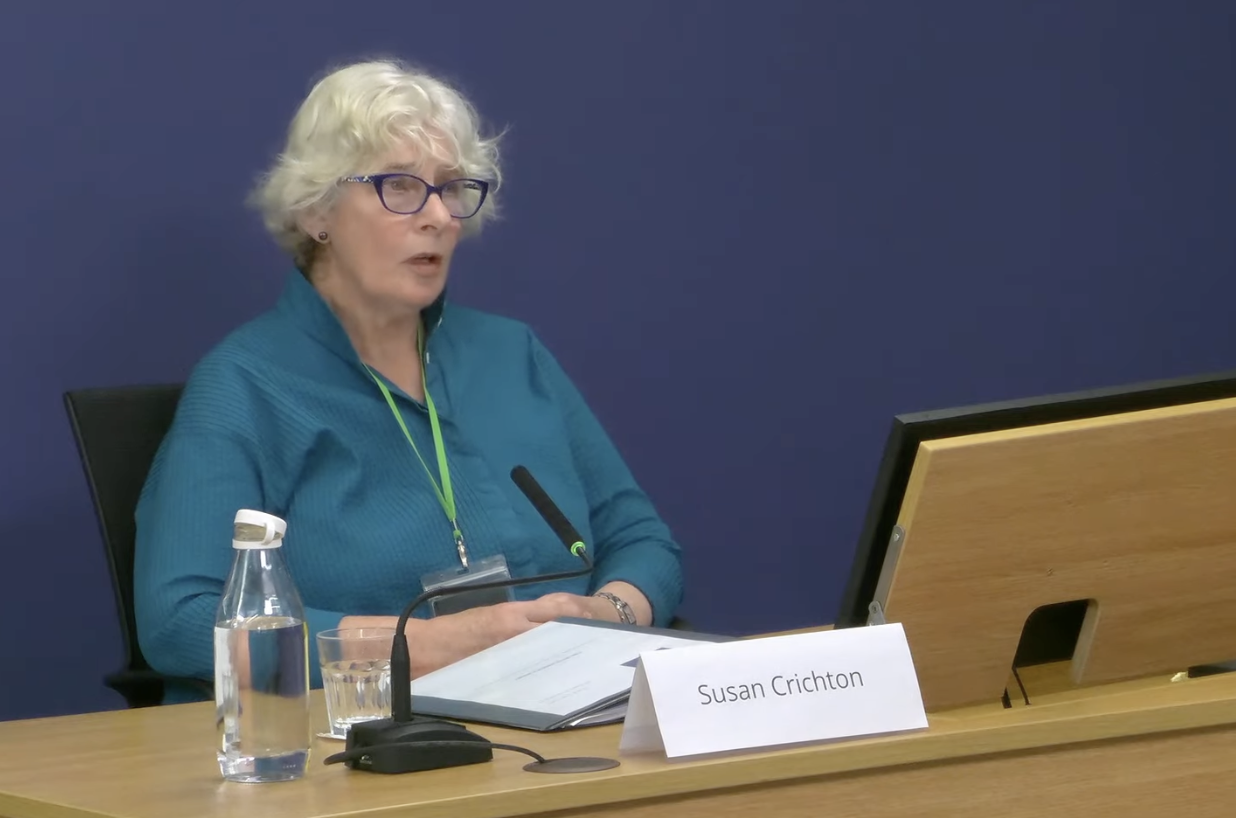
"I next turn to address relatively briefly the issue of redress. I start by restating the Department's position that it has worked very hard and in good faith to ensure that full, fair and prompt redress is paid to the Post Office's victims. There's been no lack of effort, but the Department realises that this has been too slow for many masters and their families, and it is acutely conscious that the list of those who have tragically passed away before receiving full and fair redress continues to grow. In its written closing statement, the Department has set out its position on redress in some detail, and I won't repeat that now, [but rather] use my time to address some of the bigger themes that emerge from the evidence in relation to redress."
"The first is to pick up a point made by a number of witnesses and indeed by the National Audit Office in its Government Compensation Schemes Lesson Learned Report published in July of this year. That is that there is presently no centre of expertise within government to provide guidance, expertise or a framework for public bodies seeking to better the compensation scheme. This means that each new compensation scheme involves a newly reinvented wheel or, once a compensation scheme has been launched, rebuilding the plane whilst flying it, to paraphrase Sarah Munby's evidence. The second point, related to that first point, is that it's easy in hindsight to criticise an incrementalist approach to compensation scheme design and delivery, because, as Sarah Munby described, there's a tendency to assume that it was possible to build a perfect scheme in the first place. As Sarah Munby explained, the least bad option is often to get going and make changes later rather than attempting to design the perfect scheme to start with. There's an element here of the test and learn approach suggested by Pat McLean. Of course, so much the better if the initial design, even if imperfect, were to benefit from expert input of the type proposed by the NAO. Third, the Department has regularly, proactively and constructively engaged with the Subpostmaster representatives and has regularly made improvements to the schemes in line with their suggestions. It set up the Horizon Compensation Advisory Board which has played a hugely important role. It involved the representatives of postmasters in the design of the group litigation order scheme and the Horizon Redress Scheme from the outset and it will continue with this process of engagement and incremental improvement in furtherance of those aims full, fair and prompt out of the glare of this inquiry. Fourth, while Sarah Munby and Kemi Badenoch suggested a lack of creativity in the Government. government's response. We note the Hudgell core participant group refer to a business-as-usual approach in their written closing statement. There has in fact at times been genuine innovation in the way the department and the government as a whole has approached redress. It acted to go behind the GLO settlement by creating the GLO compensation scheme and ultimately secured primary legislation to ensure the continuing power to pay. It found creative solutions to speed up progress, most obviously fixed some offers which were a novel and genuinely game-changing development, promoted the controversial and groundbreaking legislation resulting in the mass exoneration of postmasters convicted of horizon offences. These were not small things and they were not well-worn solutions. As a mark of its seriousness the government has set aside funding of 1.8 billion pounds. which the Treasury has publicly confirmed is not a limit and it's so far paid out around half a billion pounds in financial redress. These are big sums and the department is proactively looking to identify gaps in the existing schemes."
NEW: Post Office Inquiry chair says his report is "without doubt, many months away"
He is applauded out of the room.
He thanked his team and those who provided closing submissions. He thanks Subpostmasters and those who have attended for their "good humour, discipline and ability to sit through evidence and submissions which no doubt some of them felt very difficult"
Okay that's the end of the Inquiry. I'm going to try to grab some quick interviews with Subpostmasters. If you want to read the last 28 years of evidence (told over the last 3 years), please do put an advance order down for my next book – I'd be very grateful:
www.postofficescandal.uk/post/new-book-now-on-pre-sale-the-great-post-office-cover-up/
Thanks for reading!