
The Post Office has claimed it should not make public crucial documents written six years ago, partly on the grounds doing so could compromise the organisation’s capacity to receive a fair trial, should it ever face criminal proceedings over the Horizon IT scandal.
Project Brisbane is a top-secret exercise conducted in 2020 by the Post Office’s then-lawyers Herbert Smith Freehills. It is legally privileged, which means the Post Office cannot normally be forced to hand it over to the courts or even police investigators.
Today, in an information tribunal, the Post Office said handing over Brisbane “risks harming the Post Office’s ability to defend itself” in criminal and regulatory probes.
We know officers from Operation Olympos, the police investigation into potential criminality at the Post Office have at least floated the idea that the Crown Prosecution Service could bring corporate manslaughter charges against the Post Office, in the light of thirteen potential suicides linked to the scandal.
Today, the Post Office’s barrister, Robin Hopkins KC, said that even the “bad guys” have the right to keep advice from lawyers (ie legally privileged information) to themselves. Hopkins told the tribunal the Post Office also has “the rights to a fair trial and where a criminal investigation is afoot against us [and] fair trial rights… create very strong public interest rights to protect us against the loss of privilege rights.”
Project Brisbane was withheld from the public inquiry and it is only in recent weeks the police have acknowledged they are “aware” of it.
How We Got Here
Today’s information tribunal appeal hearing hung on campaigner Eleanor Shaikh’s attempt to get hold of a line of text in an email referencing a report relating to Project Brisbane.
In 2022, after a lot of to-ing and fro-ing, Eleanor was sent a bundle of government documents under a Freedom Of Information (FOI) request. These related to the handling of the Swift Review (a document also uncovered by Eleanor’s FOI work). One of the documents was an email sent in 2020 by a UK Government Investments (UKGI) employee and Post Office non-executive director called Tom Cooper. It was partially redacted. You can see the Cooper email and its one-line redaction below.
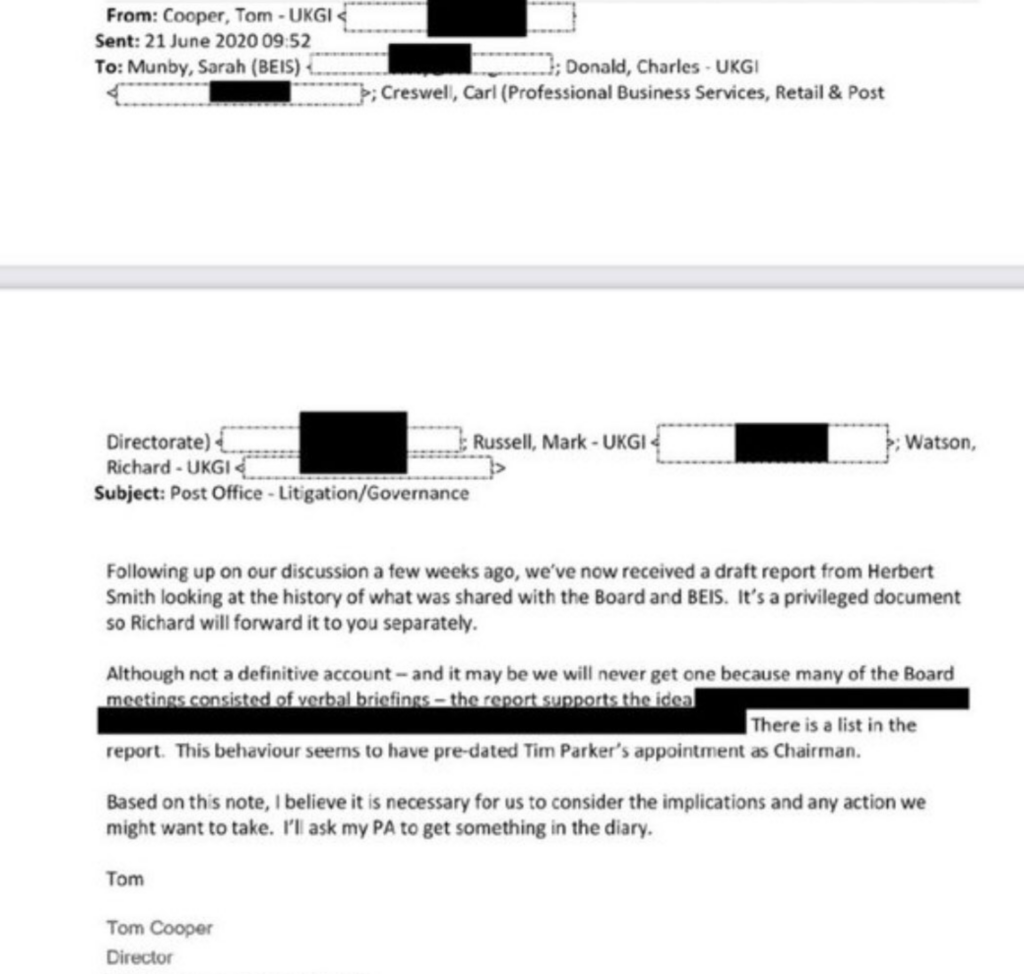
It is a message to several governmental colleagues at both UKGI and the Business Department (known at the time as BEIS). It reads:
“Following up on our discussion a few weeks ago, we’ve now received a draft report from Herbert Smith looking at the history of what was shared with the Board and BEIS. It’s a privileged document so Richard will forward it to you separately. Although not a definitive account – and it may be we will never get one because many of the Board meetings consisted of verbal briefings – the report supports the idea REDACTED REDACTED REDACTED REDACTED REDACTED REDACTED REDACTED REDACTED REDACTED REDACTED REDACTED. There is a list in the report. This behaviour seems to have pre-dated Tim Parker’s appointment as Chairman. Based on this note, I believe it is necessary for us to consider the implications and any action we might want to take. I’ll ask my PA to get something in the diary.”
From studying the material disclosed to her, Eleanor saw the “draft report” mentioned above was something to do with a mysterious and completely under-the-radar initiative which was named in another document as Project Brisbane.
Initial versions of the email (including those submitted by the Post Office to the public inquiry) had the entire second paragraph redacted. Subsequent redactions were smaller, but the Post Office has refused to unredact that remaining line.
Last year Eleanor asked for a review of the Post Office’s decision to refuse her FOI request to get the email unredacted. The Post Office reviewed and subsequently upheld its own decision. Eleanor took the matter to the Information Commissioner’s Office. In November last year, having seeing the Cooper email in full, the ICO ruled there was a public interest in publishing the email unredacted. The Post Office refused to do so, and appealed the ICO decision to an information tribunal.
That hearing was held today, the day after a tribunal over another one of Eleanor’s FOI requests – asking for the secret guidance underpinning the Horizon Shortfall Scheme. Both appeals are being considered by the same panel of judges and it’s expected that the rulings in both cases will be informed by the closeness in both subject matter and timing of the hearings. During both hearings, Eleanor was represented by the barrister Michael Deacon.
The Arguments
In his written submissions, Deacon told the tribunal “disclosure of the redacted email will provide insight into (i) what was known historically about Horizon issues by Post Office Ltd (including what information was shared with the Board and BEIS) and (ii) what was known by BEIS and UKGI in mid-2020.” He said it was “in the public interest and fundamentally important for the public to understand what underlies the redaction, as this will likely further understanding of what was known to BEIS in 2020, when it was resisting calls for the Inquiry to be placed on a statutory footing.”
Deacon recognised the information in the email (and the specific Brisbane report to which it was referring, something Post Office today called a “Memo”) was legally privileged. The argument before the tribunal was that the public interest in revealing the line in the email outweighed the privileged status of the document.
The Post Office opposed this view, not because the line in the email was likely to further the public interest and understanding of anything (which it claimed it wouldn’t), but because this would somehow be a crack in the dam of its ability to retain privilege over any legal advice it took both in 2020 and in the future.
Robin Hopkins KC, the Post Office barrister, told the tribunal that privilege should only be breached in the “rarest” instance. He also drew a distinction between privileged advice the Post Office had surrendered to the Inquiry (all relevant Horizon-related material generated before 26 Feb 2020*) and privileged material generated after that date – like Project Brisbane – which the Post Office maintained was created to advise the Post Office on the Inquiry.
Hopkins also said that revealing the content of the 2020 email “would pose a risk to its ability to protect its Legal Advice Privilege rights in respect of the Memo itself. Disclosure here would expose Post Office to arguments that its privilege rights had been waived or lost by virtue of loss of confidentiality.”
He then made his comments about criminal and regulatory investigations. Hopkins’ written arguments expand on his point. He notes the Post Office “is under an ongoing police investigation to which the issues addressed in the HSF Report [ie Brisbane] are or may be relevant. Disclosure of the redacted text could harm Post Office’s ability to defend itself in the course of that investigation and/or any ensuing prosecution that might arise, thereby compromising Post Office’s right to a fair trial. It is very strongly in the public interest to protect a potential defendant to criminal proceedings from suffering a loss of Legal Professional Privilege rights and the loss of a fair trial.”
The Post Office, having previously refused to acknowledge (to me at least) that Project Brisbane existed, now tell me Brisbane was the Post Office’s “name for the legal work undertaken by HSF, in 2020, in early preparation for the Horizon Inquiry, for which HSF went on to act as Post Office’s designated legal representative at the Inquiry. Accordingly, the report only concerned matters prior to that date. The reports are legal advice which refer to the underlying documents. They are not self-standing pieces of evidence.”
We already know, thanks to Eleanor’s search for references to Project Brisbane in documents published by the Horizon IT Inquiry, that the information generated by Project Brisbane (and Peters and Peters’ Post Conviction Disclosure Exercise) led to a recommendation that three of the Post Office’s own lawyers (Robert Wilson, Jarnail Singh and Juliet McFarlane) should be referred to the Solicitors Regulation Authority.
If Project Brisbane contains information about potential culpability for criminal acts, you might think there is a strong public interest argument in having the whole project disclosed, let alone a line in one email referring to part of it.
* The date on which Boris Johnson gave an off-the-cuff commitment to set up an inquiry into the Post Office scandal at the request of Kate Osborne MP during Prime Ministers Questions.
The journalism on this blog is crowdfunded. If you would like to join the “secret email” newsletter, please consider making a one-off donation. The money is used to keep the contents of this website free. You will receive occasional, irregular but informative email updates about the Post Office Horizon IT scandal.



Leave a Reply